
Epstein-Barr virus (EBV) infects more than 90% of the global adult population, establishing lifelong latency in B lymphocytes [1]. While most infections remain asymptomatic, EBV is causally associated with several human malignancies including Burkitt lymphoma, Hodgkin lymphoma, nasopharyngeal carcinoma, and gastric cancer [1]. Central to EBV's oncogenic potential is EBNA2 (Epstein-Barr Nuclear Antigen 2), a viral transcription factor that hijacks host cell machinery to drive B cell proliferation and survival.
The EBNA2 Regulatory Challenge
EBNA2 does not bind DNA directly. Instead, it functions as a transcriptional coactivator, recruiting host transcription factors like RBP-Jk and interacting with chromatin remodeling complexes to activate viral and cellular genes [2]. This indirect mechanism creates a complex regulatory network where EBNA2 influences hundreds of target genes, including well-characterized oncogenic drivers such as:
- CD23 (FCER2): A B cell activation marker and diagnostic indicator
- LMP1: The primary EBV oncoprotein that mimics CD40 signaling
- CCND2 (Cyclin D2): A cell cycle regulator promoting G1/S transition
- MYC: The canonical oncogene driving proliferation
Understanding which genes EBNA2 regulates, and how it coordinates with host cofactors, is essential for developing targeted therapies against EBV-associated cancers.
The Multi-Omics Data Deluge
Modern EBNA2 studies generate massive, heterogeneous datasets. A typical experiment might include:
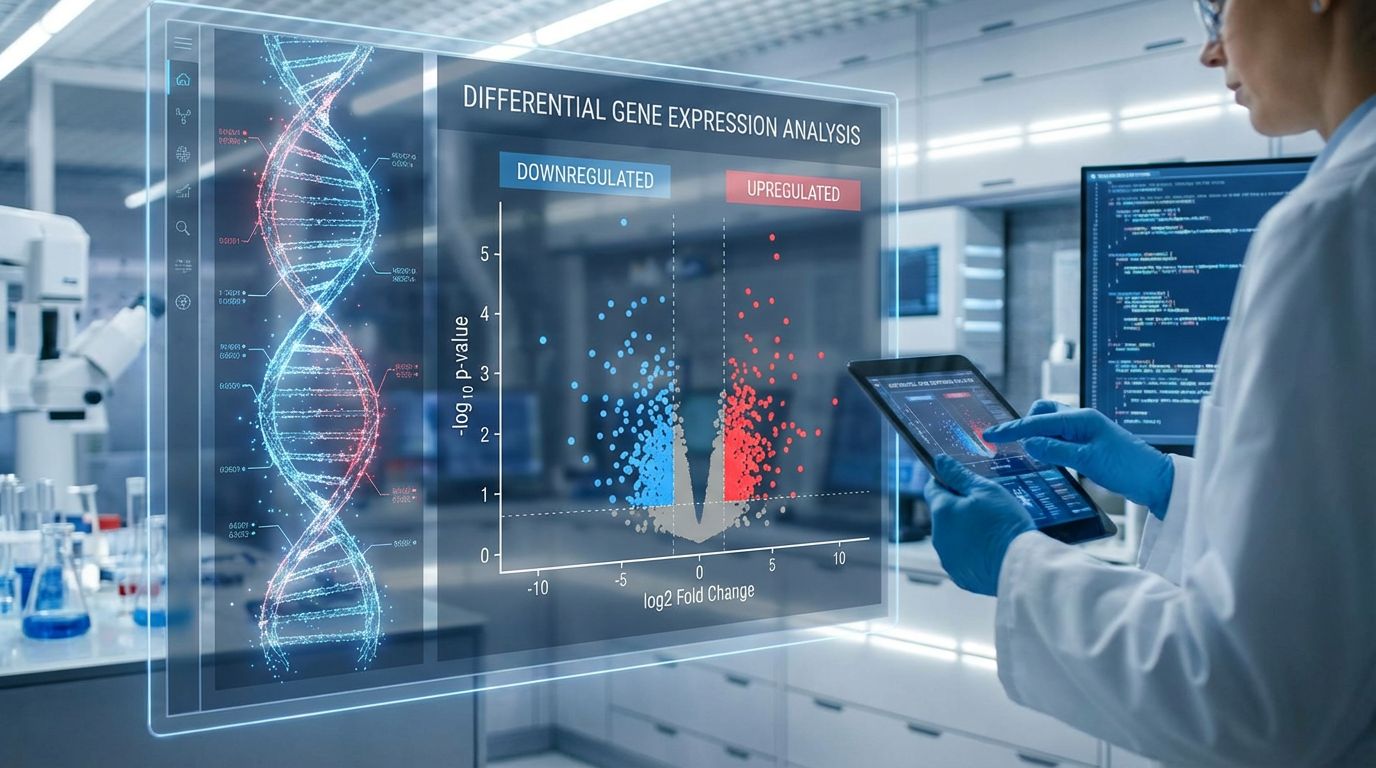
RNA-seq data identifying thousands of differentially expressed genes between EBNA2-positive and control conditions. Standard analyses yield volcano plots showing statistical significance versus fold change, but interpreting these results requires extensive manual curation.
Proteomics data from mass spectrometry revealing protein-level changes and post-translational modifications. Correlating transcript and protein abundance exposes regulatory mechanisms beyond transcription.
ChIP-seq data mapping EBNA2 binding sites and associated histone modifications across the genome, connecting transcription factor occupancy to gene expression changes.
Protein interaction networks documenting EBNA2's physical associations with hundreds of host proteins, each potentially mediating distinct regulatory functions.
A single multi-omics experiment can generate 50,000+ data points requiring integration across platforms, normalization methods, and statistical frameworks [3]. Manual analysis of such datasets typically requires weeks of specialized bioinformatics effort.
Computational Bottlenecks in Transcription Factor Research
Researchers studying EBNA2 and similar transcription factors face several analytical challenges:
Differential expression analysis requires careful statistical modeling. RNA-seq count data follow negative binomial distributions, necessitating specialized tools like DESeq2 or edgeR. Batch effects from different sequencing runs can confound results without proper correction methods like ComBat-seq [4].
Multiple testing correction is essential when testing thousands of genes simultaneously. False discovery rate control prevents spurious findings but requires balancing statistical stringency against biological sensitivity.
Pathway enrichment analysis maps differentially expressed genes to biological processes using databases like Gene Ontology, KEGG, and Reactome. Interpreting overlapping, hierarchical pathway annotations demands domain expertise.
Cross-referencing interaction databases connects expression changes to known protein-protein interactions, regulatory relationships, and disease associations distributed across UniProt, STRING, BioGRID, and specialized resources.
Integrating multi-omics layers requires sophisticated statistical methods to correlate transcriptomic, proteomic, and epigenomic signals while accounting for platform-specific biases and missing data.
AI Agents as Automated Research Partners
Intelligent computational agents can transform EBNA2 research by automating the analytical pipeline from raw data to biological insight. An AI agent configured for transcription factor analysis can:
Automate differential expression workflows: Process raw count matrices through normalization, quality control, statistical testing, and multiple testing correction without manual intervention. The agent applies appropriate methods based on experimental design and data characteristics.
Flag biologically significant targets: Beyond statistical significance, agents can prioritize genes based on fold change magnitude, known associations with EBV biology, pathway membership, and cross-study reproducibility.
Annotate pathways and functions: Automatically query pathway databases, compile enrichment results, and synthesize findings into coherent biological narratives connecting EBNA2 activity to cellular processes.
Cross-reference protein interactions: Integrate expression data with interaction networks to identify cofactors, downstream effectors, and potential therapeutic targets within EBNA2's regulatory sphere.
Generate publication-ready visualizations: Produce volcano plots, heatmaps, pathway diagrams, and network graphs with consistent formatting and appropriate statistical annotations.
Document analytical provenance: Maintain complete records of parameters, software versions, and decision points enabling reproducibility and methodological transparency.
From Weeks to Hours
Consider a typical EBNA2 RNA-seq analysis scenario: comparing gene expression between EBNA2-expressing and control B cells across multiple biological replicates. Traditional manual analysis might proceed as:
- Quality control and preprocessing (1-2 days)
- Alignment and quantification (1 day)
- Differential expression analysis (2-3 days)
- Result interpretation and pathway analysis (3-5 days)
- Figure generation and documentation (2-3 days)
An AI agent can compress this timeline dramatically by executing standardized workflows, parallelizing independent analyses, and eliminating idle time between steps. More importantly, the agent maintains consistency across experiments, enabling direct comparison of results from different studies or time points.
Enabling Discovery at Scale
The acceleration provided by AI agents opens new research possibilities:
Systematic cofactor screening: Test how different host transcription factors modify EBNA2's regulatory output by analyzing dozens of perturbation experiments in parallel.
Temporal dynamics: Profile EBNA2 target gene expression across infection time courses, capturing the sequential activation of viral and cellular programs.
Cross-study meta-analysis: Integrate public EBNA2 datasets to identify robust, reproducible regulatory relationships that transcend individual experimental contexts.
Therapeutic target prioritization: Rank potential drug targets based on centrality in EBNA2 networks, druggability predictions, and expression specificity in EBV-associated cancers.
The Path Forward
As multi-omics technologies become more accessible and datasets grow larger, the bottleneck in transcription factor research increasingly shifts from data generation to data interpretation. AI agents that combine statistical rigor with biological knowledge can democratize sophisticated analyses, enabling researchers to focus on hypothesis generation and experimental validation rather than computational bookkeeping.
For EBNA2 and other viral transcription factors with oncogenic potential, this acceleration could meaningfully impact the development of targeted therapies for virus-associated cancers affecting millions worldwide.
References
[1] Damania B, Kenney SC, Raab-Traub N. "Epstein-Barr virus: Biology and clinical disease." Cell. 2022;185(20):3652-3670. https://doi.org/10.1016/j.cell.2022.08.026
[2] SoRelle ED, et al. "Epstein-Barr virus evades restrictive host chromatin closure by subverting B cell activation and germinal center regulatory loci." Cell Reports. 2023;42(8):112958. https://doi.org/10.1016/j.celrep.2023.112958
[3] Vandereyken K, Sifrim A, Thienpont B, Voet T. "Methods and applications for single-cell and spatial multi-omics." Nature Reviews Genetics. 2023;24(8):494-515. https://doi.org/10.1038/s41576-023-00580-2
[4] Zhang Y, Parmigiani G, Johnson WE. "ComBat-seq: batch effect adjustment for RNA-seq count data." NAR Genomics and Bioinformatics. 2020;2(3):lqaa078. https://doi.org/10.1093/nargab/lqaa078
[5] Soldan SS, Lieberman PM. "Epstein-Barr virus and multiple sclerosis." Nature Reviews Microbiology. 2023;21(1):51-64. https://doi.org/10.1038/s41579-022-00770-5