
Frequently Asked Questions
MorphMind is the trademarked brand and d/b/a of AIScientists, Inc., founded in 2025 by Professor Jie Ding (University of Minnesota) and Professor Jia Liu (Harvard University). MorphMind’s mission is to enable researchers to build AI research partners that accelerate their work and preserve their expertise.
For enterprises, MorphMind protects competitive advantage while accelerating internal R&D. For academia, it shortens research timelines and enables reproducible, cumulative science.
AgentLab is MorphMind’s flagship product—the world’s first platform of AI Scientists that empowers domain experts to create their own custom AI research partners.
Each agent functions like a Research or Professional Assistant that can chat and conduct research: searching literature, analyzing data, performing scientific computing, writing and deploying software, and generating results.
No. Traditional AI agents require teams of engineers and weeks or months to design, build, and deploy. MorphMind is a platform that allows any user without AI or engineering expertise to create agents through natural language and deploy them instantly to a secure private cloud.
These agents automate workflows, reduce engineering overhead, minimize hallucinations, and let experts focus on insights. In this sense, MorphMind is not a single agent—it is a super-agent platform capable of creating many agents.
MorphMind supports experts across scientific and technical domains, including:
- For PhD Students and Postdocs: Agents help generate hypotheses, design experiments, deploy to private cloud, monitor execution, and analyze results, speeding publication cycles and graduation timelines.
- For Principal Investigators and Research Labs: Capture and institutionalize lab knowledge in reusable agents that improve onboarding, reproducibility, collaboration, and documentation.
- For Startups and SMEs: Access domain-specific agents without building large AI engineering teams. This strengthens go-to-market credibility and accelerates product development.
- For Enterprises and Industrial R&D Teams: Build in-house knowledge agents that preserve expertise, support auditable decision-making, and comply with regulatory expectations, especially during personnel transitions or large-scale onboarding.
Unlike chatbots or single-function AI tools, AgentLab provides an end-to-end environment—no copy/paste across ChatGPT, VS Code, RStudio, SPSS, etc. All agent actions and rationales are transparent to users. Unlike AI coding assistants, MorphMind’s agents think, plan, and collaborate with humans. They evolve with usage, understanding needs more precisely over time.
At the core, MorphMind continuously updates domain-specific operators, workflows, and foundation models to maintain rigor in scientific reasoning. The result: transparency, reproducibility, and trustworthiness.
If you’ve built agents before, you already know the pain of orchestrating memory, long context, tool calls, and data management. But modifying, sharing, or deploying these agents is often difficult.
With AgentLab, you can recreate your existing agent logic within minutes using your current code snippets, then standardize, reuse, and share it without deployment hassle. It becomes effortless to reproduce, maintain, and collaborate on agents.
AgentLab supports prototyping with public or simulated data, and all code can be downloaded locally.
If you choose to upload private data, they remain secure within our SOC II and HIPAA-compliant AWS infrastructure. Users always retain full ownership and control.
We also offer customized private-cloud deployments for enterprises with stringent security requirements.
No—not unless you explicitly opt in.
Enterprise deployments enforce a strict one-direction information flow: enterprise users may access public information, but enterprise data cannot flow back into our platform. This ensures regulatory-grade protection suitable for pharma, biotech, and other sensitive industries.
AgentLab is built primarily on proprietary models, information-processing algorithms, and agentic orchestration frameworks. However, AgentLab supports a wide range of third-party APIs when users choose to provide them—for example, paid databases, custom search engines, or specialized analysis tools.
In short, we support any user-supplied API as long as it is provided during usage.
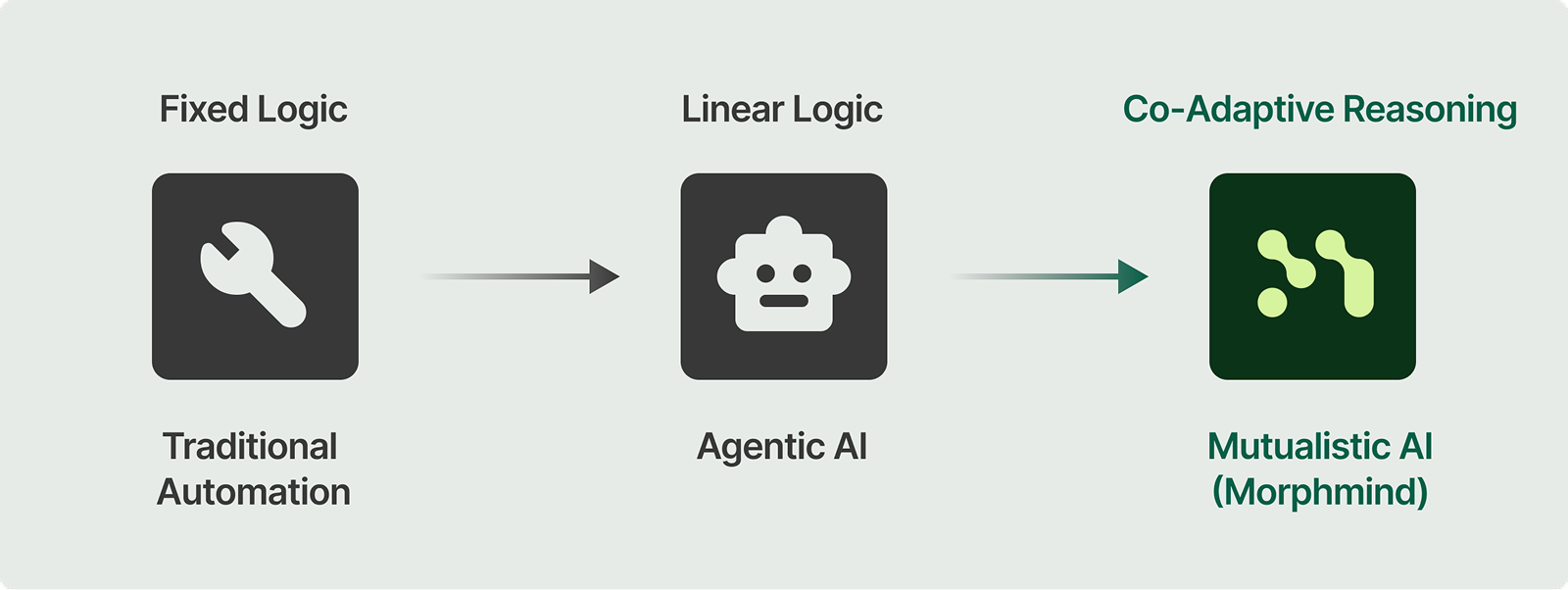
Mutualistic AI is a paradigm in which humans and AI learn together through continuous interaction. Humans bring creativity, intuition, and judgment; AI contributes scale, pattern recognition, and computation. Like mutualistic relationships in nature, each strengthens the other to create intelligence neither could achieve alone.
Unlike static automation or standard agentic AI, mutualistic AI evolves with domain experts, allowing human judgment and machine reasoning to reinforce each other.
Over recent decades, research-and-development (R&D)–intensive industries have grown enormously in both scale and complexity. Global R&D expenditures reached more than US $2.75 trillion in 2023, having nearly quadrupled from around US $726 billion in 2000. Life sciences and pharmaceutical R&D exceeded $300 billion globally in 2023, yet laboratory research operations remain constrained by fragmented data, manual experimentation, and siloed domain expertise. Meanwhile, generative AI and enterprise analytics promise to drive the next wave of productivity gains and innovation.
However, despite this scale of investment, many domain professionals remain constrained not by data or compute per se, but by tool-and-workflow mismatches.
Mutualistic AI is a new paradigm where humans and AI learn together via continuous interaction. Experts provide creativity, intuition, and domain judgment. AI contributes scale, pattern recognition, and rapid computation. Like mutualistic relationships in nature, each strengthens the other. The result is a shared intelligence greater than what either party could achieve alone.