
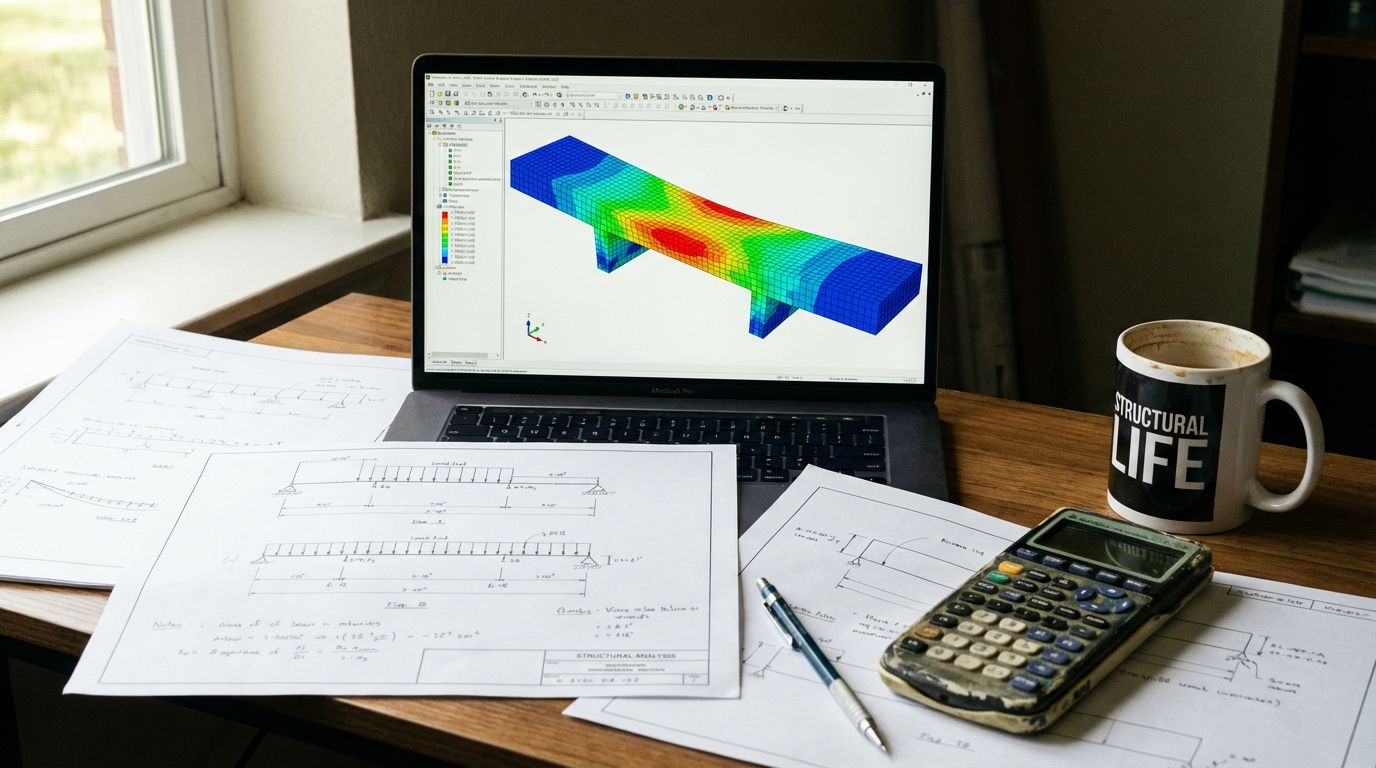
From beam geometry to validated convergence analysis in minutes
What Researchers Get
The Finite Element Model Agent automates the complete FEM workflow for structural beam analysis—from problem definition through error quantification. No manual matrix assembly. No debugging convergence issues. Just rigorous, validated results.
Agent Capabilities
| Capability | What It Does |
|---|---|
| Define geometry | Set beam dimensions, material properties (E, I), load conditions |
| Assemble FEM system | Build global stiffness matrix using Hermite cubic elements |
| Solve with BCs | Apply boundary conditions, solve symmetric positive-definite system |
| Analytical validation | Compute exact solutions for comparison |
| Error metrics | L2, L-infinity, energy norms with relative errors |
| Convergence studies | Automated h-refinement with rate verification |
| Generate reports | Publication-ready tables and analysis summaries |
Demo: Cantilever Beam Convergence Study
Problem setup:
- Length: 10 m
- Material: Steel (E = 200 GPa)
- Cross-section: I = 1e-4 m^4
- Loading: Point load P = 1000 N at tip
Analytical solution: w_tip = -PL^3 / (3EI) = -16.667 mm
Results: Hermite Cubic Elements
| Elements | Mesh Size (m) | Tip Deflection (mm) | Relative Error |
|---|---|---|---|
| 2 | 5.000 | -16.6666666667 | 0.00e+00 |
| 4 | 2.500 | -16.6666666667 | 1.71e-14 |
| 8 | 1.250 | -16.6666666667 | 5.20e-15 |
| 16 | 0.625 | -16.6666666667 | 3.35e-14 |
| 32 | 0.312 | -16.6666666670 | 1.84e-11 |
| 64 | 0.156 | -16.6666666618 | 2.94e-10 |
Key finding: Errors at machine precision (10^-14 to 10^-16) with just 2 elements. Hermite cubics exactly capture cubic polynomial deflection fields.
Demo: 2D Plane Stress Comparison
Problem: Same cantilever, now modeled with Q4 bilinear elements
- Dimensions: 48 x 12 x 1 (L/H = 4)
- Material: E = 30 MPa, nu = 0.25
- Mesh: 24 x 6 = 144 Q4 elements (350 DOFs)
Results: Q4 vs Beam Theory
| Method | Tip Deflection (mm) | vs Beam Theory |
|---|---|---|
| Euler-Bernoulli (analytical) | -8.533 | reference |
| Q4 FEM (centerline) | -8.766 | +2.72% |
Key finding: Q4 elements predict larger deflection because they capture shear deformation that Euler-Bernoulli theory neglects. For slender beams (L/H > 10), difference diminishes; for deep beams (L/H < 2), Q4 is more accurate.
Built-In Domain Knowledge
The agent encodes expertise across 7 areas:
- Euler-Bernoulli theory — Governing equation, assumptions, analytical solutions
- Weak form derivation — Integration by parts, bilinear forms, variational principles
- Hermite cubic elements — 4 DOFs/element, C1 continuity, exact stiffness matrices
- System assembly — Local-to-global mapping, BC enforcement, solver selection
- Convergence theory — O(h^4) L2 error, O(h^3) energy norm, pre-asymptotic behavior
- Error norms — L2, L-infinity, energy; absolute and relative metrics
- Quality standards — Mesh quality, symmetry checks, physical validation
Why This Matters for Researchers
Traditional FEM workflow:
- Write assembly code (hours)
- Debug indexing errors (hours)
- Implement boundary conditions (hours)
- Validate against analytical solutions (hours)
- Run convergence studies manually (hours)
With FEM Agent:
- Define problem → Get validated results (minutes)
- Automatic convergence verification
- Built-in analytical benchmarks
- Publication-ready error tables
References
[1] Hughes TJR. The Finite Element Method: Linear Static and Dynamic Finite Element Analysis. Dover Publications; 2000.
[2] Zienkiewicz OC, Taylor RL. The Finite Element Method. 7th ed. Butterworth-Heinemann; 2013.
[3] Bathe KJ. Finite Element Procedures. 2nd ed. Prentice Hall; 2014.